
Science, Research & Psilocybin Healing
For thousands of years, sacred mushrooms have been used in ceremony for healing, insight, grief, prayer, and remembrance.
Long before clinical trials, brain scans, and Western medicine had language for “neuroplasticity” or “treatment resistant-depression” people sat with these medicines and discovered something deeply human: sometimes healing does not come from adding something new. Sometimes it comes from remembering what has always been here.
Today, the world’s leading institutions — including Johns Hopkins University, NYU Langone, Stanford Medicine, and Imperial College London — are studying psilocybin with a level of rigor that would have been almost unimaginable just a decade ago.
What they are finding is quietly extraordinary. Not because psilocybin is magic, and not because mushrooms “fix” people, but because in the right setting, with the right preparation, support, and integration, psilocybin appears to help people reconnect with parts of themselves that trauma, depression, addiction, grief, and years of conditioning may have buried.
This is not hype. It is science beginning to catch up to what sacred traditions never forgot.
01 — Johns Hopkins University
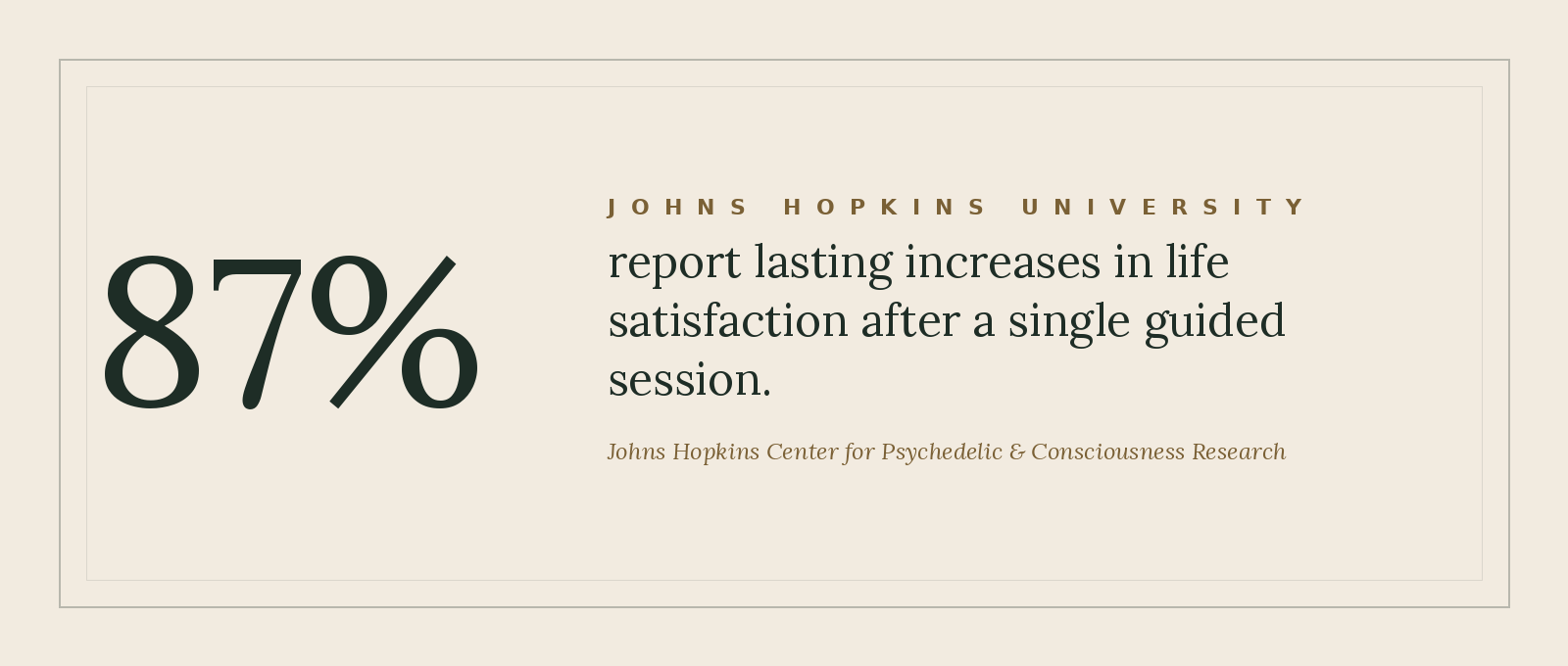
87% reported increases in well-being or life satisfaction
Researchers at Johns Hopkins have published some of the most respected work in the field of psychedelic science. Their studies on psilocybin have explored depression, anxiety, addiction, spiritual experience, and end-of-life distress, with findings that continue to shape the entire field.
In one landmark Johns Hopkins study, patients facing life-threatening cancer experienced substantial and sustained decreases in depression and anxiety after psilocybin-assisted therapy, along with increases in quality of life, life meaning, optimism, and death acceptance.
According to Johns Hopkins Medicine’s summary of the study, 87% of participants reported increases in well-being or life satisfaction, and many described the experience as one of the most personally meaningful or spiritually significant experiences of their lives.
In later research on major depressive disorder, Johns Hopkins found that psilocybin-assisted therapy produced rapid and large reductions in depressive symptoms. A follow-up study from Johns Hopkins Medicine found that these antidepressant effects may last beyond one year.
That matters because many people who come to this work are not looking for a temporary escape. They are looking for something real. Something that lasts. Something that helps them relate to themselves, their pain, and their life in a fundamentally different way. The miracle is a perceptual shift.
The research does not suggest psilocybin is a cure-all. It suggests something more subtle and, in many ways, more powerful: under the right conditions, a single carefully supported experience can become a turning point.
02 — NYU Langone
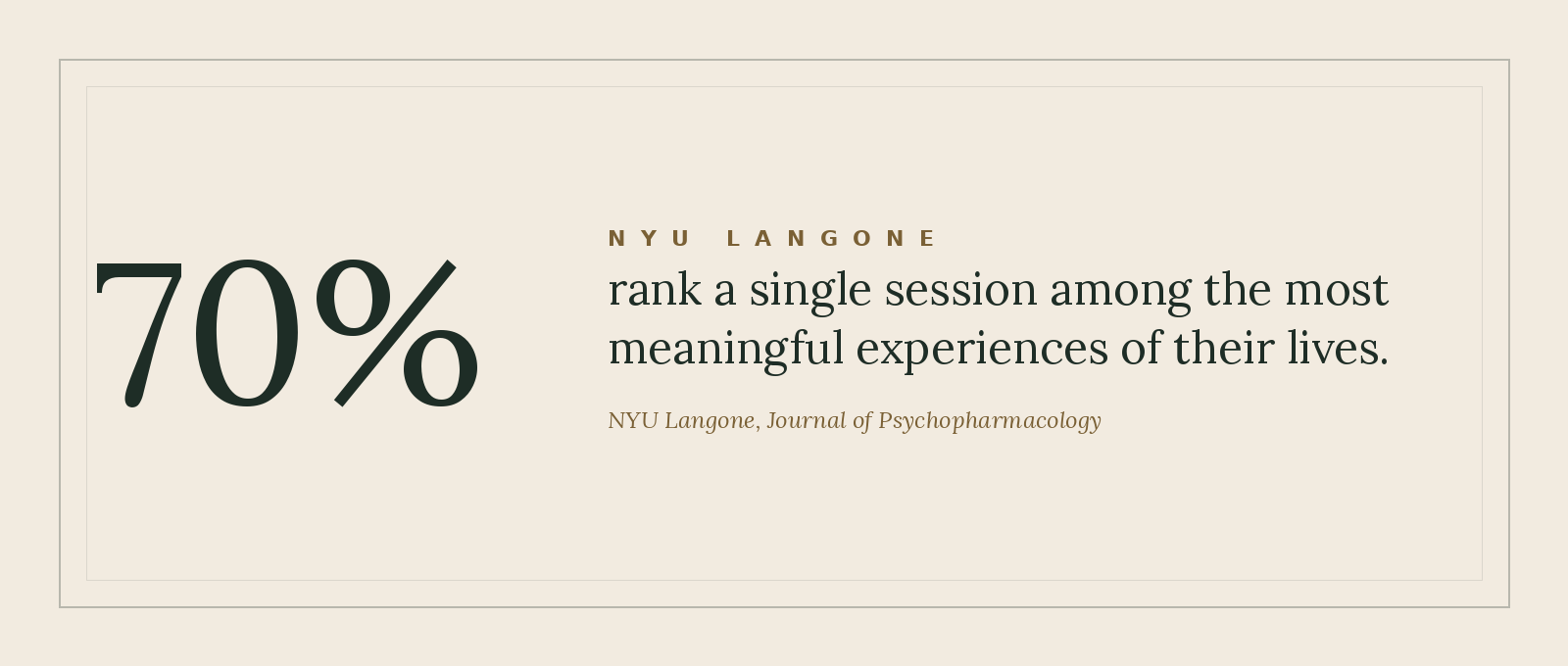
70% described it as one of the most meaningful experiences of their lives
NYU Langone’s psilocybin research has been especially important in the study of cancer-related anxiety, depression, existential distress, and alcohol use disorder.
In a randomized clinical trial at NYU, patients facing life-threatening cancer experienced rapid and sustained reductions in anxiety and depression after psilocybin-assisted therapy. Six months later, a large majority reported improvements in quality of life, meaning, and spiritual well-being.
Many participants in psilocybin studies describe the experience not simply as symptom relief, but as one of the most meaningful experiences of their lives — sometimes comparable to the birth of a child, the death of a loved one, or a profound spiritual awakening.
That is not typical language in medicine. And yet it appears again and again in this research.
Because sometimes healing is not only chemical. Sometimes healing is existential. Sometimes what changes is not just mood, but meaning. Not just symptoms, but relationship — to self, to grief, to love, to death, to life.
NYU’s research into alcohol use disorder also points in this direction. In a JAMA Psychiatry study led by NYU researchers, participants receiving psilocybin-assisted psychotherapy showed significant reductions in heavy drinking days compared with placebo-assisted therapy. According to NYU Langone’s summary, participants who received psilocybin reduced heavy drinking by 83% on average relative to their drinking before the study began.
For many, the change was not simply about resisting a behavior. It was about relating to themselves and their lives differently.
03 — Stanford Medicine
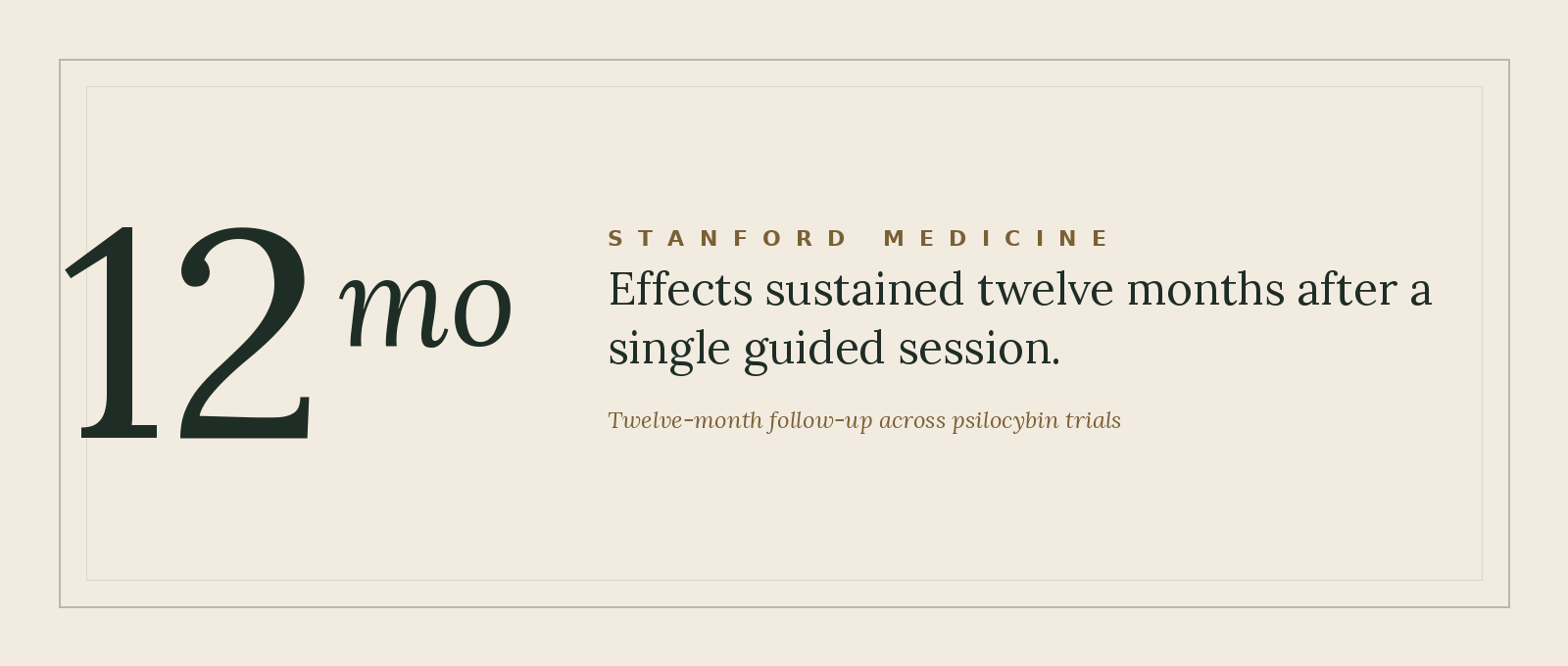
The experience itself may matter
One of the most important shifts in psychedelic research is the growing recognition that the subjective experience may not be incidental to the healing process. The experience may be part of what makes change possible.
Stanford Medicine has written about this directly: in psychedelic therapy, the experience matters. Their work points to a growing body of evidence that psilocybin may enhance neuroplasticity — the brain’s capacity for change — which mental illness often constricts.
This is where the clinical and the sacred begin to speak to each other.
A mystical or deeply meaningful experience is not just a strange side effect. For many people, it may be the very thing that allows healing to begin. A person may see their grief differently. They may feel love where there was numbness. They may touch a sense of self that is not defined by depression, trauma, addiction, or fear.
This does not mean the experience is always easy. It does not mean everyone should do it. And it does not mean the medicine does the work for you.
But it does suggest that healing is not always linear, intellectual, or purely behavioral. Sometimes healing comes through direct experience. Sometimes something opens, and from that opening, a new life becomes possible.
04 — Imperial College London
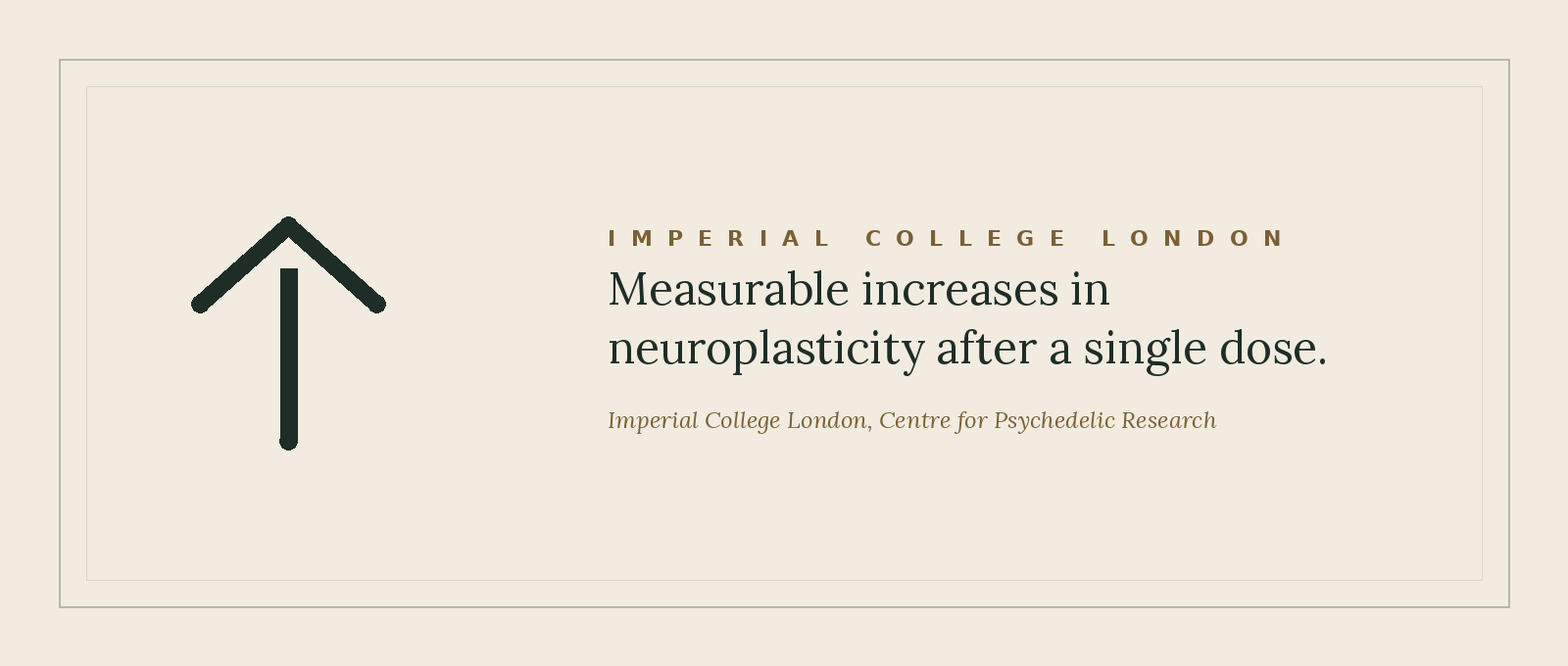
The brain becomes more flexible
Imperial College London has done some of the most important research on psilocybin, depression, and the brain.
Their work has also explored what may be happening neurologically when psilocybin is taken. Studies suggest that psilocybin can temporarily increase flexibility in brain networks, allowing rigid patterns to loosen and new connections to become possible.
In simple terms: the brain may become more open to change.
And for many people living with depression, trauma, addiction, or years of feeling stuck, this matters. Because healing often begins when we are no longer trapped inside the same story.
This is also why integration matters so deeply. The medicine may open a door, but what you do afterward shapes what grows. The days and weeks after a ceremony can be a powerful window for new habits, new choices, new honesty, and new ways of being with yourself.
The experience is not the end of the work. In many ways, it is the beginning.
05 — Federal Policy
The door is beginning to open
For more than half a century, the federal posture toward psilocybin and other psychedelic medicines was one of suppression. Research was interrupted. Clinical inquiry was restricted. And medicines that had been used ceremonially for generations were placed behind a wall of fear, stigma, and legal restriction.
But something is shifting.
On April 18, 2026, President Donald J. Trump signed an executive order titled Accelerating Medical Treatments for Serious Mental Illness. The order directs federal agencies to reduce barriers around psychedelic research and treatment development for serious and treatment-resistant mental illness.
According to the White House fact sheet, the order points toward priority review for qualifying psychedelic drugs that have received Breakthrough Therapy designation, expanded pathways for eligible patients through Right to Try, $50 million in ARPA-H funding for state-partnered psychedelic research, increased clinical trial access, and rescheduling review after successful Phase 3 trials and FDA approval.
It does not mean the work is finished. But it does mean the federal government is beginning to acknowledge what the research has been showing for years: these medicines deserve to be studied seriously.
And for many people who have tried everything — medication, therapy, self-help, spiritual practice, lifestyle change — that matters. Not because science replaces the sacred, but because science is beginning to make room for it.
Where We Are Now
For most of the twentieth century, psilocybin research was silenced. Not because the early findings were empty, but because the political climate made the work almost impossible to continue.
Now the science is beginning to confirm what many wisdom traditions have held for generations: when approached with respect, support, and reverence, these medicines can become catalysts for profound transformation.
What has happened since is remarkable. The research has returned. The science has deepened. The federal posture is beginning to shift.
The door is beginning to open. The container is ready.
The question now is, are you?
